Kyptec Automation® Expands High Resolution Machine Vision Lens Portfolio for 5 MP, 10 MP and 25 MP Industrial Camera Systems
VMPL
New Delhi [India], September 12: Kyptec Automation® is expanding its high resolution industrial imaging portfolio with a structured range of 5 MP, 10 MP and 25 MP Machine Vision Lens families developed for modern industrial camera systems, OEM machine platforms, vision system integrators and precision automation requirements. The current Kyptec Automation® Machine Vision Lens collection contains 31 products spanning multiple focal lengths, sensor formats and optical resolution classes, giving engineering teams the ability to select optics according to camera architecture, required field of view, working distance and image detail rather than treating focal length as the only selection parameter. The expansion strengthens the company’s position in industrial imaging as camera sensors continue to move toward greater resolution, smaller pixels and more demanding optical performance.
At the center of the portfolio is a clear engineering principle: increasing camera megapixels does not automatically increase usable inspection detail unless the optical system can transfer sufficient resolution and contrast to the sensor. A camera sensor, lens, pixel size, sensor format, working distance, field of view, aperture and illumination environment operate as one imaging system. If the lens becomes the limiting component, additional camera resolution may not translate into additional useful image information. Kyptec Automation® is therefore building its machine vision lenses around differentiated optical classes so OEMs and system integrators can match lens capability to the actual camera and imaging requirement.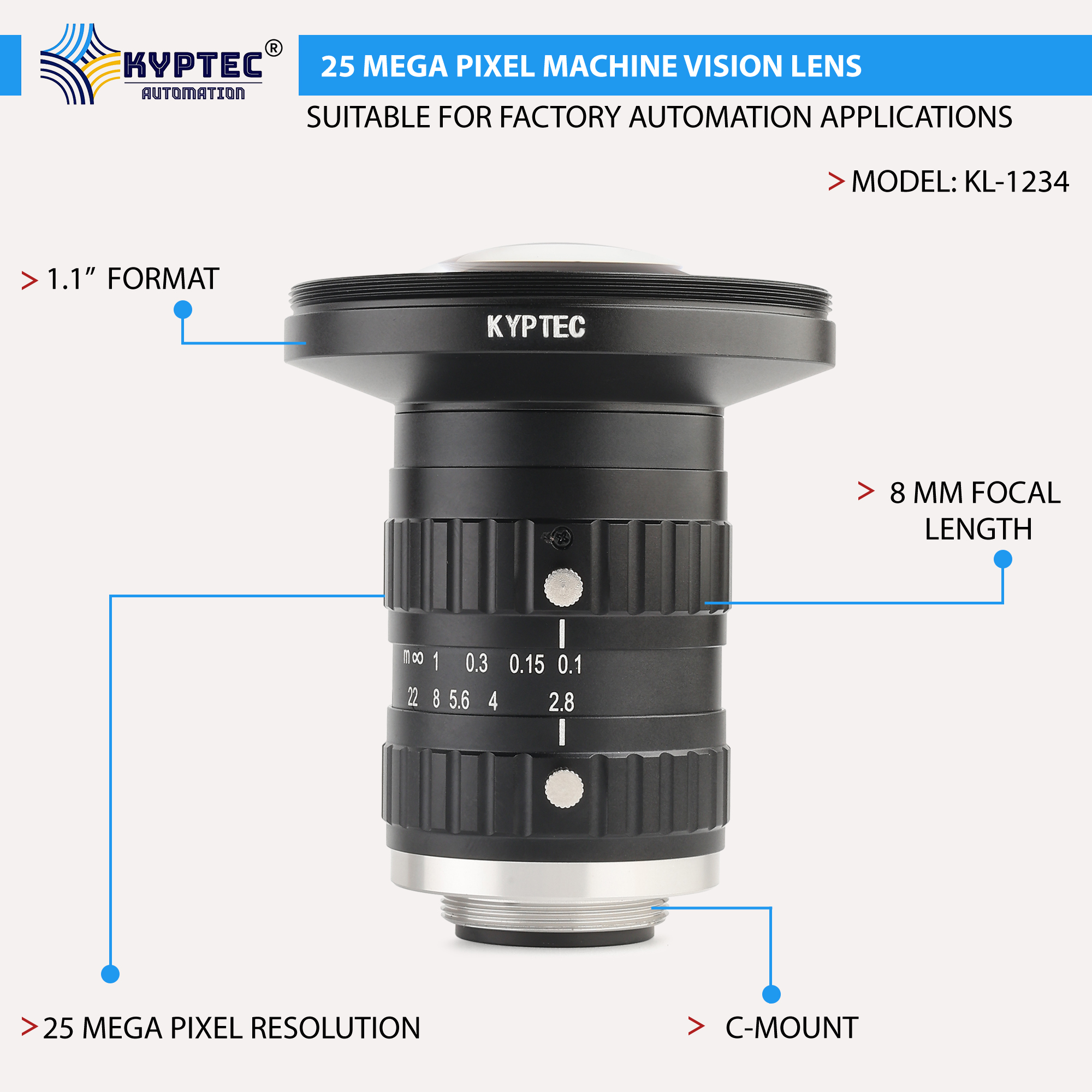
The 5 MP portfolio provides a defined optical family for compatible 2/3 inch industrial camera systems and currently includes focal lengths such as 8 MM, 12 MM, 16 MM, 25 MM and 35 MM. These configurations provide engineering flexibility where the required inspection resolution, sensor format and machine geometry can be satisfied without unnecessary optical specification. For machine builders, this allows lens selection to begin with practical imaging requirements such as required object coverage, smallest feature size, camera distance and available installation space. The objective is not to specify the highest resolution lens for every system, but to select an optical class capable of supporting the camera architecture and required image detail consistently.
Kyptec Automation® also provides extensive 10 MP coverage for industrial camera systems requiring greater optical resolution. Its current portfolio includes 10 MP Machine Vision Lens families for both 2/3 inch and 1 inch sensor formats, with multiple focal lengths available across these optical classes. This distinction is important because megapixel rating alone does not determine whether a lens is appropriate for a camera. Sensor dimensions influence image circle requirements and field of view, while pixel size influences the level of optical detail the camera can potentially sample. Engineers must therefore consider resolution and sensor coverage together when qualifying optics for an industrial imaging platform.
For higher resolution systems, Kyptec Automation® has developed a 25 MP family designed around the larger 1.1 inch format. The current range includes 8 MM, 12 MM, 16 MM, 25 MM, 35 MM and 50 MM focal lengths, enabling machine builders to address different fields of view and working distances while remaining within a common high resolution optical architecture. A representative 25 MP machine vision lens combines 25 MM focal length with 1.1 inch format coverage, illustrating how Kyptec Automation® is pairing optical resolution, focal length and sensor format within defined product families rather than presenting megapixel capability as an isolated specification.
This structured approach is particularly important as industrial imaging systems become more demanding. A larger field of view can reduce the number of pixels representing each millimeter of the inspected object, while smaller defects require sufficient image sampling to remain distinguishable. Increasing camera resolution can improve available sampling, but only when the selected lens preserves adequate detail across the required image area. Lens resolution, sensor format, optical contrast, distortion, aperture, depth of field, working distance and illumination must therefore be considered together. Kyptec Automation® is positioning its portfolio around these relationships so optical selection can be based on measurable system requirements rather than generalized assumptions about megapixel ratings.
“Higher camera resolution is valuable only when the optical system is capable of delivering the detail the sensor is expected to capture,” said Nitin Aggarwal, Co Founder and CEO of Kyptec Automation®. “Our 5 MP, 10 MP and 25 MP lens families are designed to give OEMs and system integrators multiple optical classes so they can select according to sensor format, required field of view, working distance and inspection detail. Our objective is to make machine vision lens selection more systematic and to build deeper engineering capability around the relationship between industrial cameras and precision optics.”
For OEMs, a structured lens portfolio can also simplify standardization across machine platforms. An equipment manufacturer may need one optical family for moderate resolution systems, another for cameras requiring greater image detail and a larger format family for premium imaging platforms. Within each architecture, multiple focal lengths can help engineers adapt the field of view and working distance without repeatedly qualifying unrelated optical products. This creates a stronger foundation for documentation, repeat manufacturing, replacement planning, procurement consistency and future machine revisions.
Kyptec Automation® is also strengthening the technical information surrounding its optical portfolio because lens selection increasingly begins through digital research. Engineers searching for an industrial camera lens often need to compare focal length, megapixel capability, sensor size, C mount compatibility, field of view, working distance, image circle and optical resolution before contacting a supplier. Clear specification relationships help buyers determine whether a lens matches the camera and whether the selected resolution class is appropriate for the smallest feature that the imaging system must reproduce.
The expanded 5 MP, 10 MP and 25 MP portfolio supports the broader Kyptec Automation® strategy of building specialist authority in machine vision optics and industrial imaging technology. By offering clearly differentiated resolution families across multiple focal lengths and sensor formats, the company is strengthening its ability to support OEMs, system integrators and machine builders that require precision optics for repeatable industrial camera systems. As camera technology continues to advance, Kyptec Automation® plans to deepen its optical portfolio around the engineering factors that ultimately determine useful image quality, including sensor compatibility, resolution, contrast, field of view and reliable optical performance.
CONTACT US:
Kyptec Automation®
C/o BalaJi MicroTechnologies Pvt. Ltd.
(A Unit of B.B. Group Of Companies)
NO# C-79, UPPER GROUND FLOOR,
DDA SHEDS OKHLA INDUSTRIAL AREA,
OKHLA PHASE-1, NEW DELHI-110020, INDIA
Email ID: support@kyptec-automation.com
Website: https://www.kyptec-automation.com/
Mobile/WhatsApp: +91-9217165630
(ADVERTORIAL DISCLAIMER: The above press release has been provided by VMPL. ANI will not be responsible in any way for the content of the same)